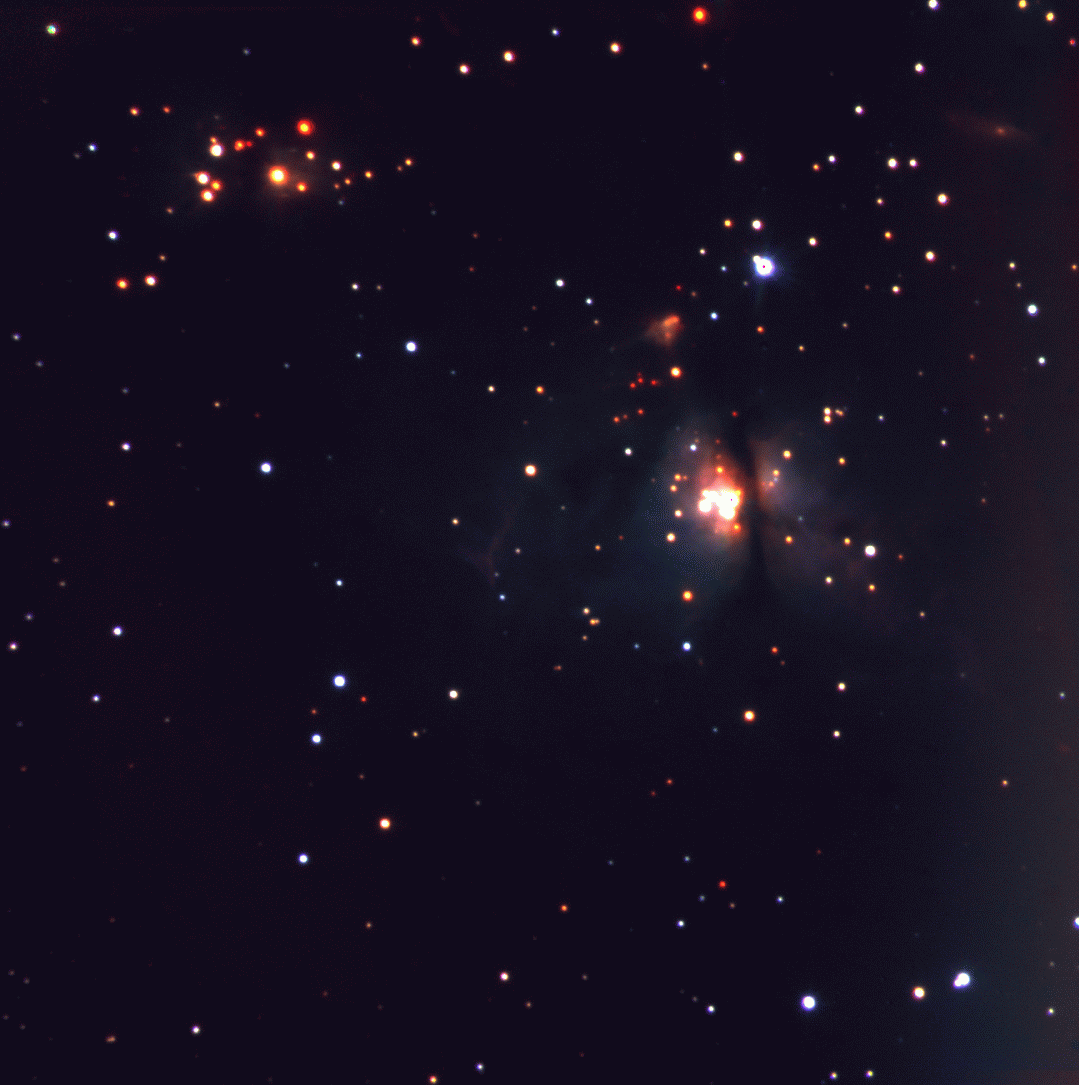
Flamingos captures the NS14 star-forming region
 |
 |
|
|
The left-hand picture is a J, H, K-short (1.25, 1.65, 2.2um) composite image of the high-mass star formation region NS 14, also known as RAFGL 5216, BFS 57, and BIP 14. This object was first identified by Neckel & Staude (1984, A&A, 131, 200) as a bipolar nebula at a distance of 2.3 kpc (7500 light years), NS 14 is excited by four stars closely packed toward the brighter center of the nebula in an ultracompact HII region. A dense dust lane, or torus, bisects the nebula, giving it a bipolar appearance.
NS14 was observed as part of a science verification program during the commissioning of FLAMINGOS-I at Gemini South on the night of 13 October, 2001. The field-of-view is 135x135 arcsec. The total exposure time was 4 min at J and H-band and 7.5 min at K-short. The final image quality is 0.44 arcsec at J,K-short and 0.37 arcsec at H.
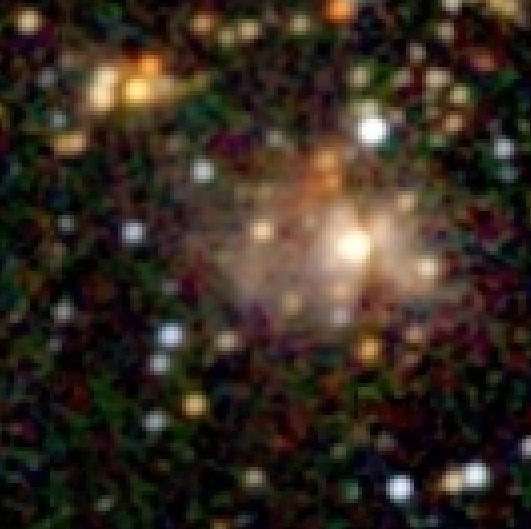
On the right, the equivalent field as viewed by the 2MASS survey is given for comparison (extracted from the 2MASS gallery).

