GNIRS Update 12 December 2005
Successful upgrade, new Instrument Scientist and other news
This
"Hot News" article describes a few GNIRS changes during the second half
of 2005 including engineering work, a new Gemini instrument scientist,
a GNIRS talk at the Tucson NGO meeting and a data reduction note.
Engineering Upgrade - No More Spots!
GNIRS underwent a major engineering "intervention" in
July-Sept 2005. The work had two primary objectives (as well as a
number of secondary ones): 1) replacement of the forward lenses in the
short cameras with the radio-active coatings to eliminate the radiation
events on the detector; and 2) installation of 3 new filters-- a
cross-dispersed filter with improved blue sensitivity (replacing the
old one), and two narrowband acquisition filters (H_2 at 2.12um and PAH
at 3.29um). With the expert help of mechanical technician Ron
George and GNIRS principal investigator Jay Elias from Tucson, along
with the hard work of several Gemini engineers and scientists, the
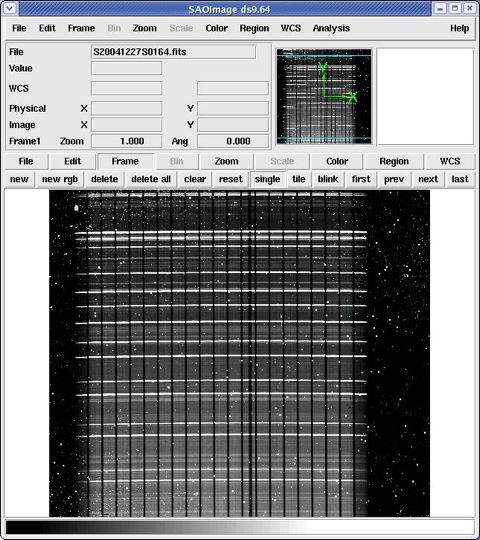
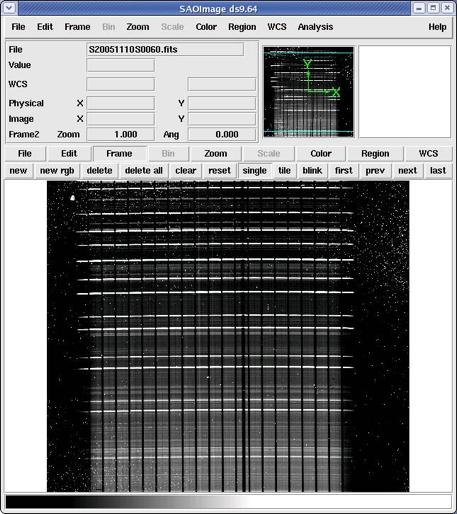
operation was completely successful. Figure 1 illustrates the
improvement in long exposures without the bothersome radiation
events. More information about the upgrade can be found in the GNIRS talk at the Tucson NGO meeting
[9Mb, powerpoint file] in November. Mechanical repair work on the OIWFS gimbal mechanism
was also completed during the engineering period, and appears to have
been successful, however additional software and integration work
remain before the OIWFS will be available for regular use.
Figure 1. Two 900 second GNIRS
IFU exposures, taken Dec 2004 (with old camera lenses) and Nov 2005
(after camera lens replacement). No more spots!
Between the engineering work, PWFS2 problems that put it out of service
for much of October, and more than our fair share of lousy Spring
weather, we got a late start on the GNIRS queue programs in
2005B. However, we've made up for lost time recently and are now
happy to report that we have completed all of GNIRS Band 1 observations
that have been observable so far, including DD and rollover, and we are
making good progress on Band 2, as well as Band 3.
Other News
Greg Doppmann has taken over the position of GNIRS Instrument Scientist
as of November 2005. Greg joined Gemini as a Science Fellow in
September 2004 with considerable NIR spectroscopy experience and has
been working with GNIRS since his arrival.
Have a look at Greg's talk on GNIRS at the Tucson NGO meeting
[9Mb, powerpoint file] in November 2005. He discusses the recent upgrade results and GNIRS Phase II issues, among other things.
Due to the change in the cameras, two new database files are needed for reducing GNIRS short camera data with the Gemini/GNIRS IRAF package. More information is available in an email sent to GNIRS PIs, and the two files are available on the Gemini FTP site.
The updated files will be included in the next IRAF release.