
| You are in: Instruments > GNIRS |
|
|
GNIRS Introduction |
| Click on the image to see a close-up view of GNIRS on Gemini South | 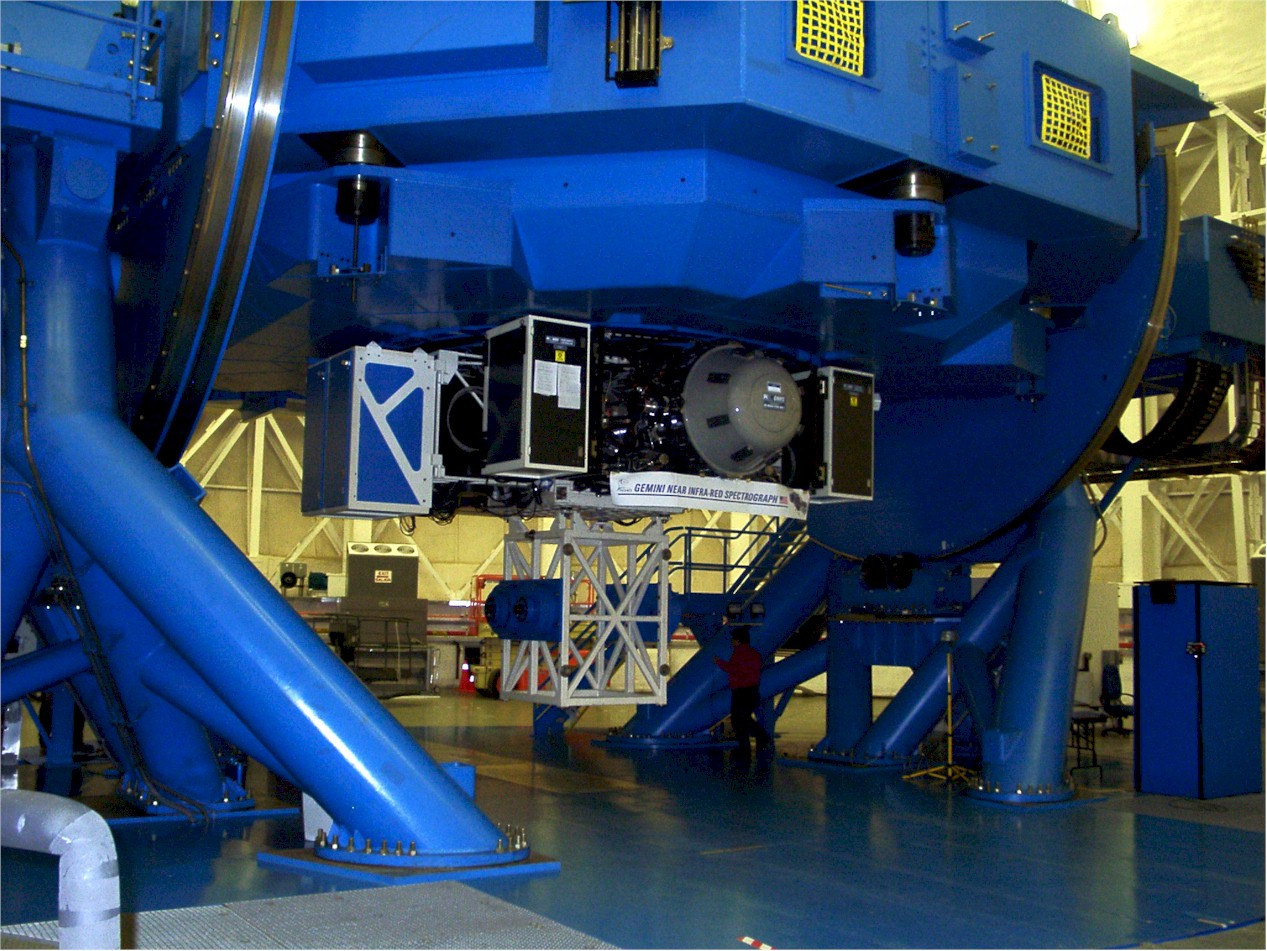
|
GNIRS was built by NOAO in Tucson, Arizona and delivered to Cerro Pachon in late October 2003; an Integral Field Unit (IFU) built by the University of Durham was integrated into the instrument early in 2004. Commissioning of the majority of the modes took place in stages during 2004. GNIRS was first made available for science use in 2004B and is currently available to the community in queue and classical modes. For more information on the available modes and restrictions, please see the latest Call for Proposals.
GNIRS offers a wide variety of spectroscopic capabilities including long-slit (single order) spectroscopy within the 1-5.5um range at 2-pixel spectral resolutions of approx 1700, 5900 and 18000 with a choice of 2 pixel scales (0.15"/pix and 0.05"/pix); cross-dispersed spectroscopy giving simultaneous coverage of 1-2.5um at R~1700 and partial coverage at 5900; integral field unit (IFU) spectroscopy from 1-5.5um over a 5 arcsec field with a pixel scale of 0.15"/pix. GNIRS is also equipped with a Wollaston prism that could be used for spectral polarimetry in conjunction with an external polarization unit (not currently available). The different pixel scales are achieved with four cold-changeable cameras of "long" and "short" focal lengths optimized for "blue" (1-2.5um) and "red" (3-5um) wavelengths. There is an on-instrument wavefront sensor with a HgCdTe detector to allow guiding on near-infrared bright stars; however commissioning of the OIWFS is not complete and it is not available for use. The standard Gemini peripheral wavefront sensors (PWFS1 and PWFS2), operating in the optical, must be used for guiding at this time.
See the contents list for more on capabilities, performance and system
verification status. The information on these pages is a combination
of empirical results from commissioning and early-use, and information from
the GNIRS Users Manual delivered with the instrument and written primarily
by Jay Elias, the NOAO principal instrument scientist.


Last update June 24, 2005; Bernadette Rodgers