|
|
NIRI Optical Overview
|
|
The pupil mask/filter wheel is of a similar design as the two filter
wheels, is 530mm in diameter and contains apertures for up to 12 masks
and filters. The nominal pupil image has a diameter of 36mm. In
fact, this is where the 5 NIRI grisms (transmission grating prisms)
are located to facilitate observations in its spectroscopic mode.
Also, mounted here is a Wollaston prism analyser (for imaging
polarimetry observations) together with a selection of masks/stops
(for alignment and background suppression) and a PK50 thermal-IR flux
blocker. Coronographic masks will also be placed in the this wheel.
The design of the pupil mask/filter wheel, again, modular in that the
wheel and housing can be easily removed from NIRI. Below is a photo
of the pupil mask/filter wheel prior to installation in NIRI.
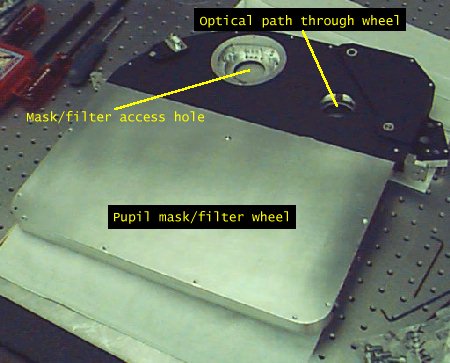
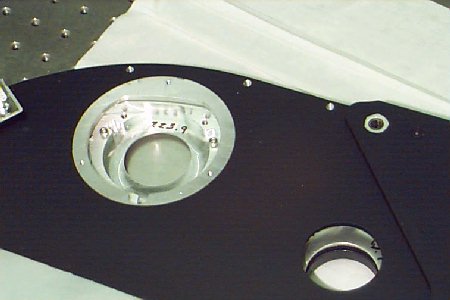
The photo below shows a closer view of the two holes in the pupil mask/filter wheel. The larger hole is the mask/filter access hole while the smaller hole is the telescope beam path through the wheel.
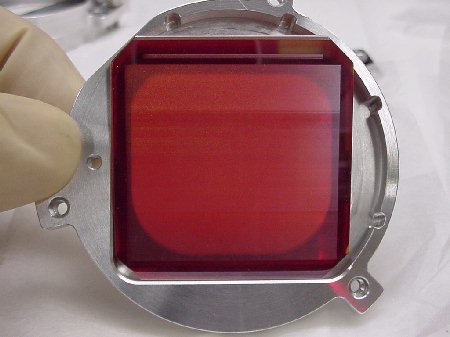
The current NIRI grisms have been designed to give a spectral resolution of between 2000 and 4000, are direct-ruled KRS-5 and made by Zeiss in Germany. Each grism costs approximately $16000. KRS-5 has a higher index of refraction than other, more typical, grism materials and hence, for a smaller path length a larger dispersion is obtained. Below is a photo of one of the 5 NIRI grisms in its holder ready for mounting in the pupil mask/filter wheel.
The view below shows a different perspective on the KRS5 grism showing its compact size.
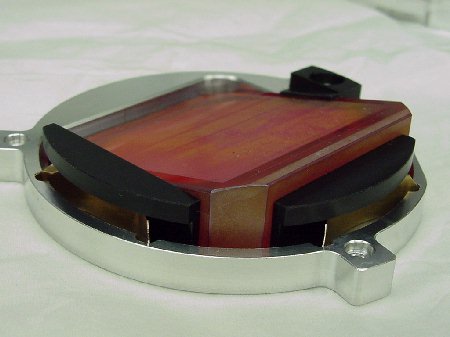
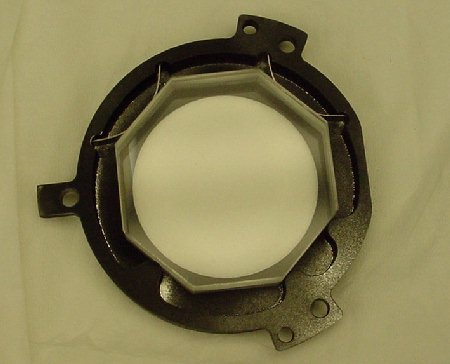
The Wollaston prism analyser for imaging polarimetry with NIRI is shown in the photo below. The prism is made of MgF2 and is ~47mm is diameter and hexagonal in shape. It produces a spatial separation of orthogonal polarization components (the o- and e-rays) of incident radiation of ~3.7" (32 pixels using the f/6 camera) on the NIRI science detector. The Wollaston prism will be used in conjunction with the GPOL polarimetric retarder unit located external to NIRI in the A&G box above the Instrument Support Structure (the ISS). For imaging polarimetry of extended sources a focal plane mask blocking radiation from sections of the array will be used. In these regions the radiation from the orthogonal polarization state will be imaged (after spatial displacement by the analyser).
|
Last update August 2, 2000; Colin Aspin