- Announcements
- PIO
- Sciops
- Gemini Home
- Telescopes and Sites
- Science Visitors at Gemini
- Observing With Gemini
- Instruments
- Retired Instruments
- NORTH
- ALTAIR
- GMOS
- GNIRS
- NIFS
- NIRI
- GRACES
- SOUTH
- FLAMINGOS-2
- GeMS
- GMOS
- GPI
- GSAOI
- VISITING
- Multi-Object Spectroscopy
- Visiting Instrument Policy
- Visiting Instrument Telescope Interfaces
- DSSI Speckle Camera
- TEXES (North)
- Integration Time Calculators
- Magnitudes and Fluxes
- Near-IR Resources
- Mid-IR Resources
- Observing Condition Constraints
- Performance Monitoring
- SV/Demo Science
- Future Instrumentation & Current Development
- Queue and Schedules
- Data and Results
- Gemini Research Staff
- Helpdesk
- Statistics
- Call for Proposals
- Contact
- enewscast
- Instrument Upgrades: Small Project Examples
- IUSP RfP: Frequently asked questions and additional information
- Library
Change page style:
Photometric zero points
Photometric zero points
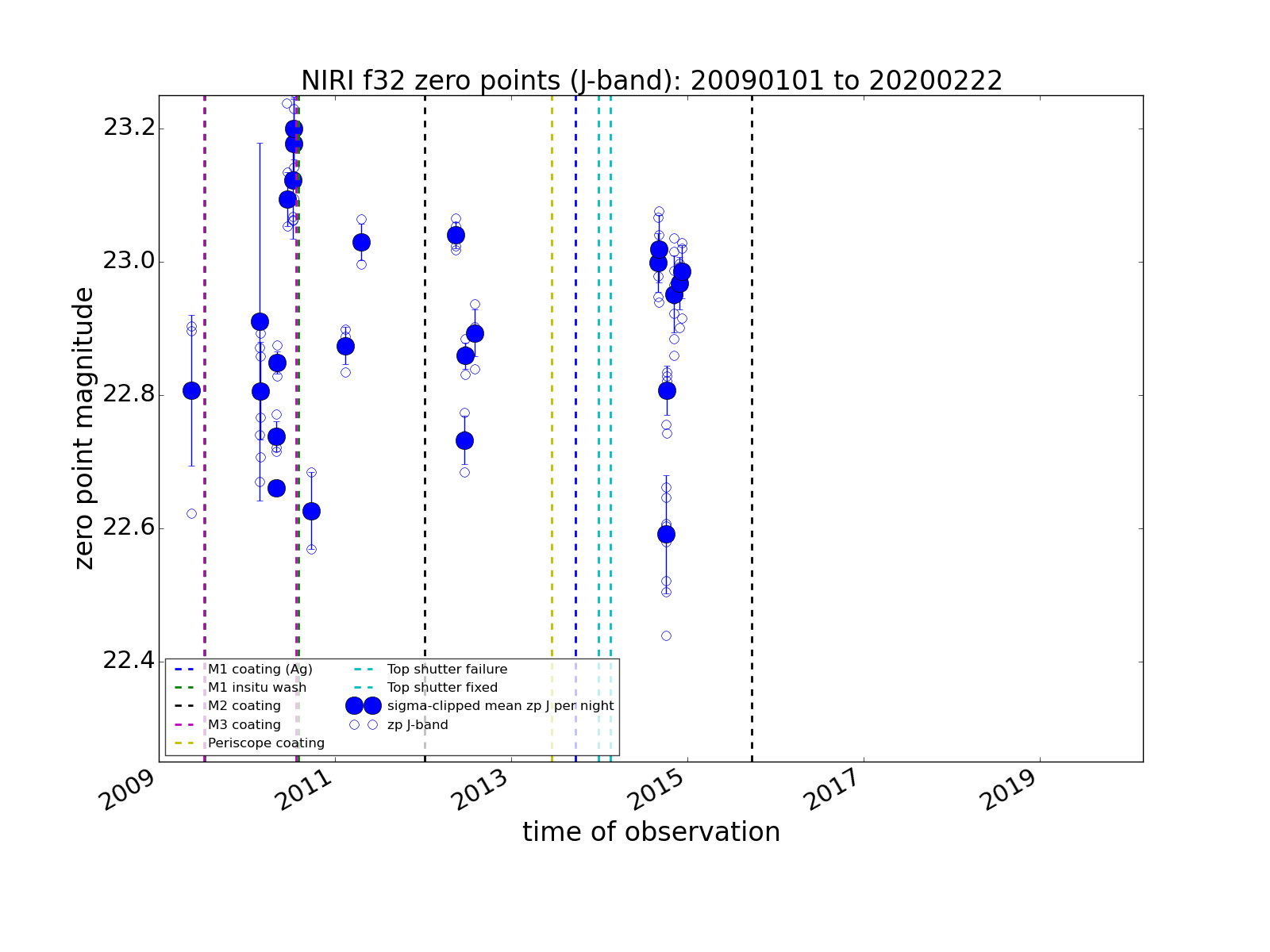
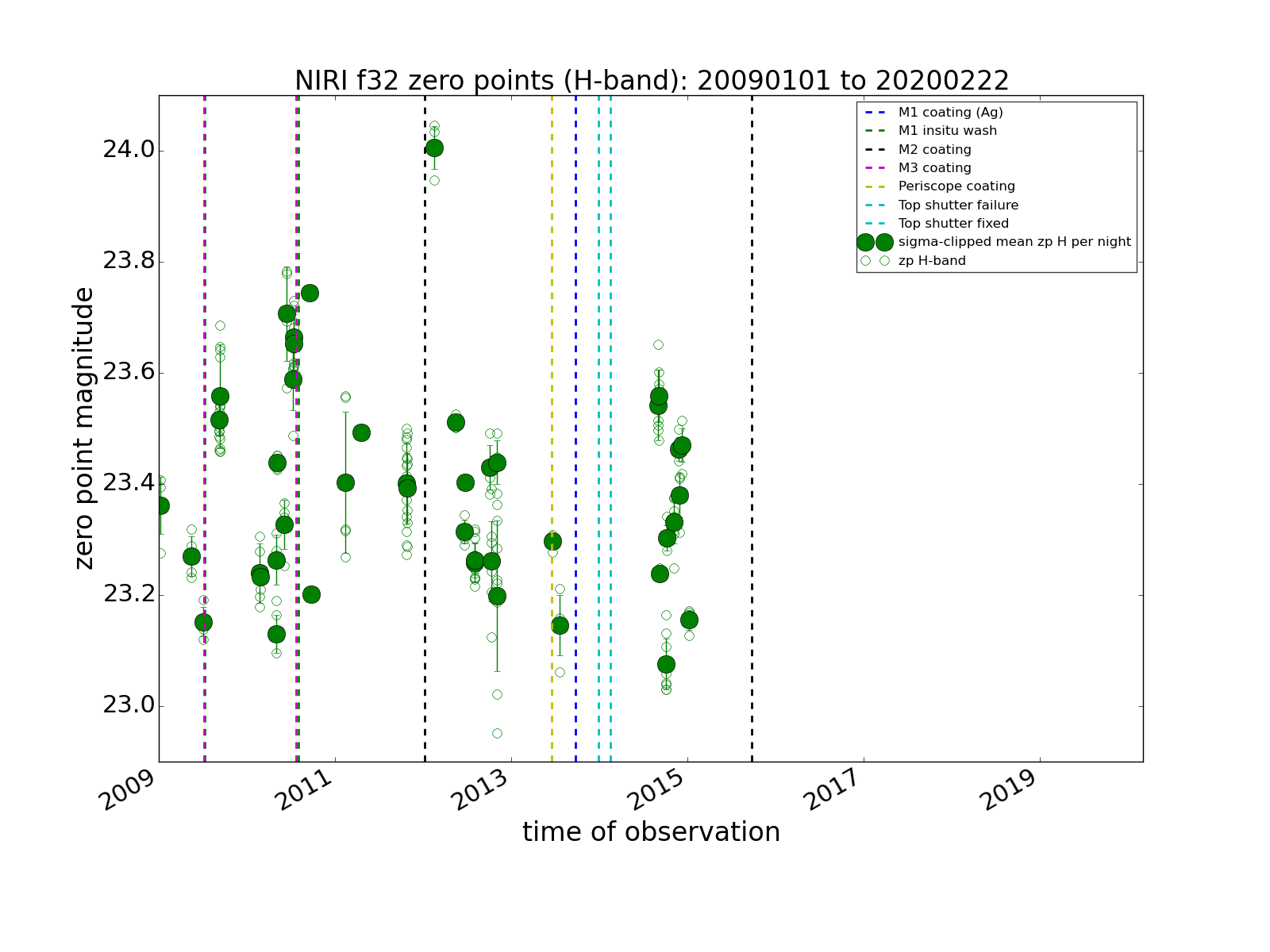
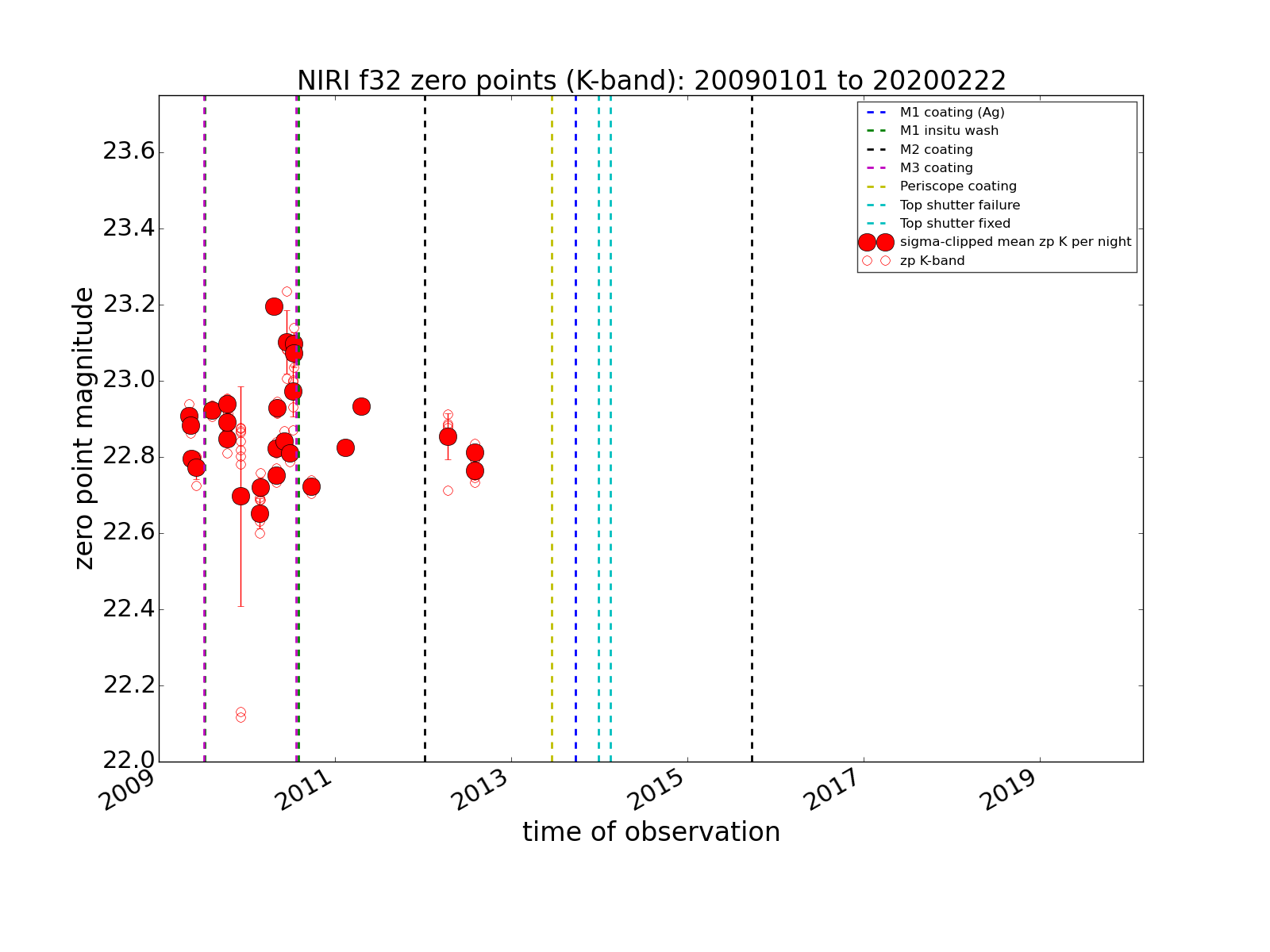
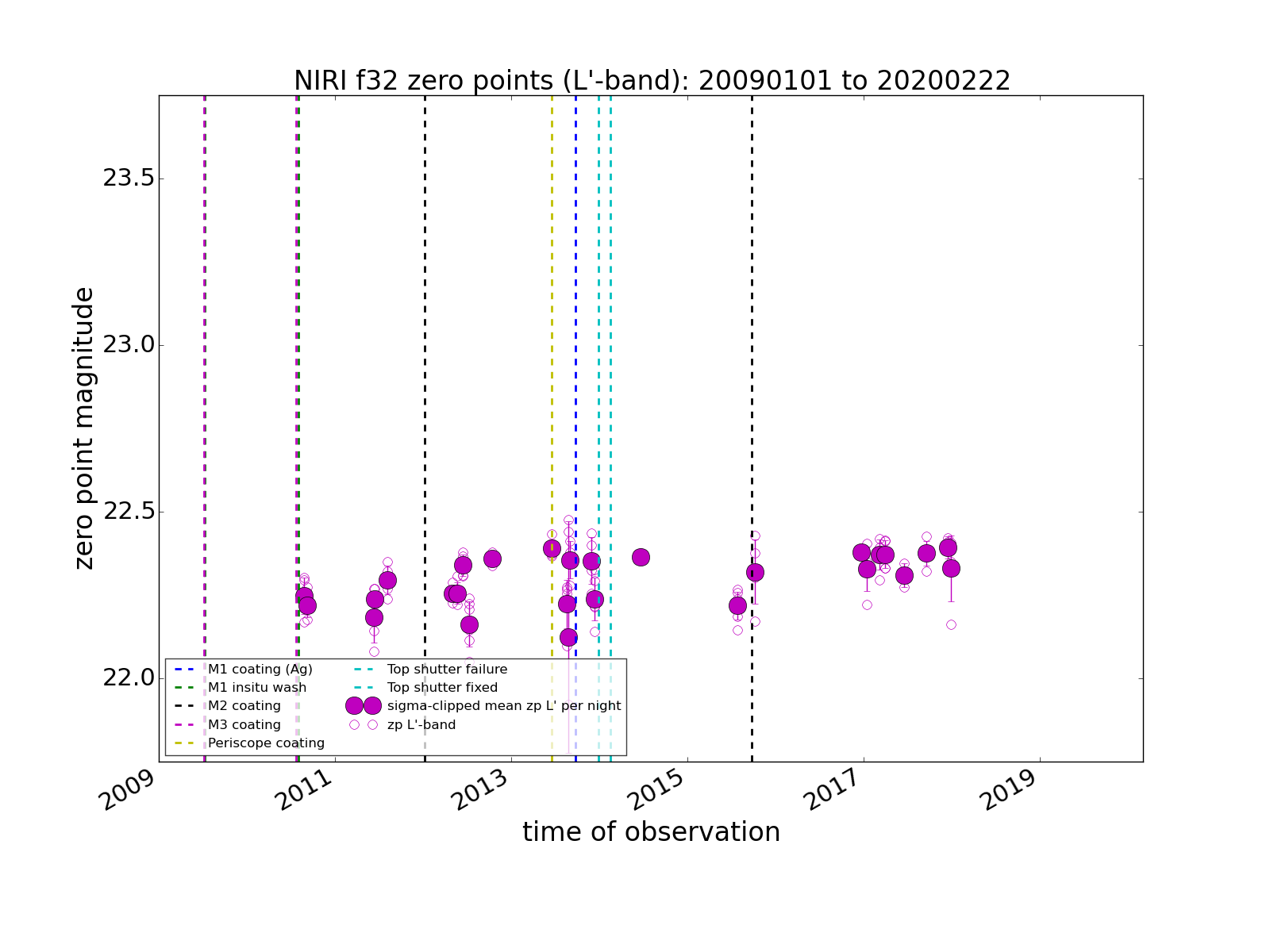
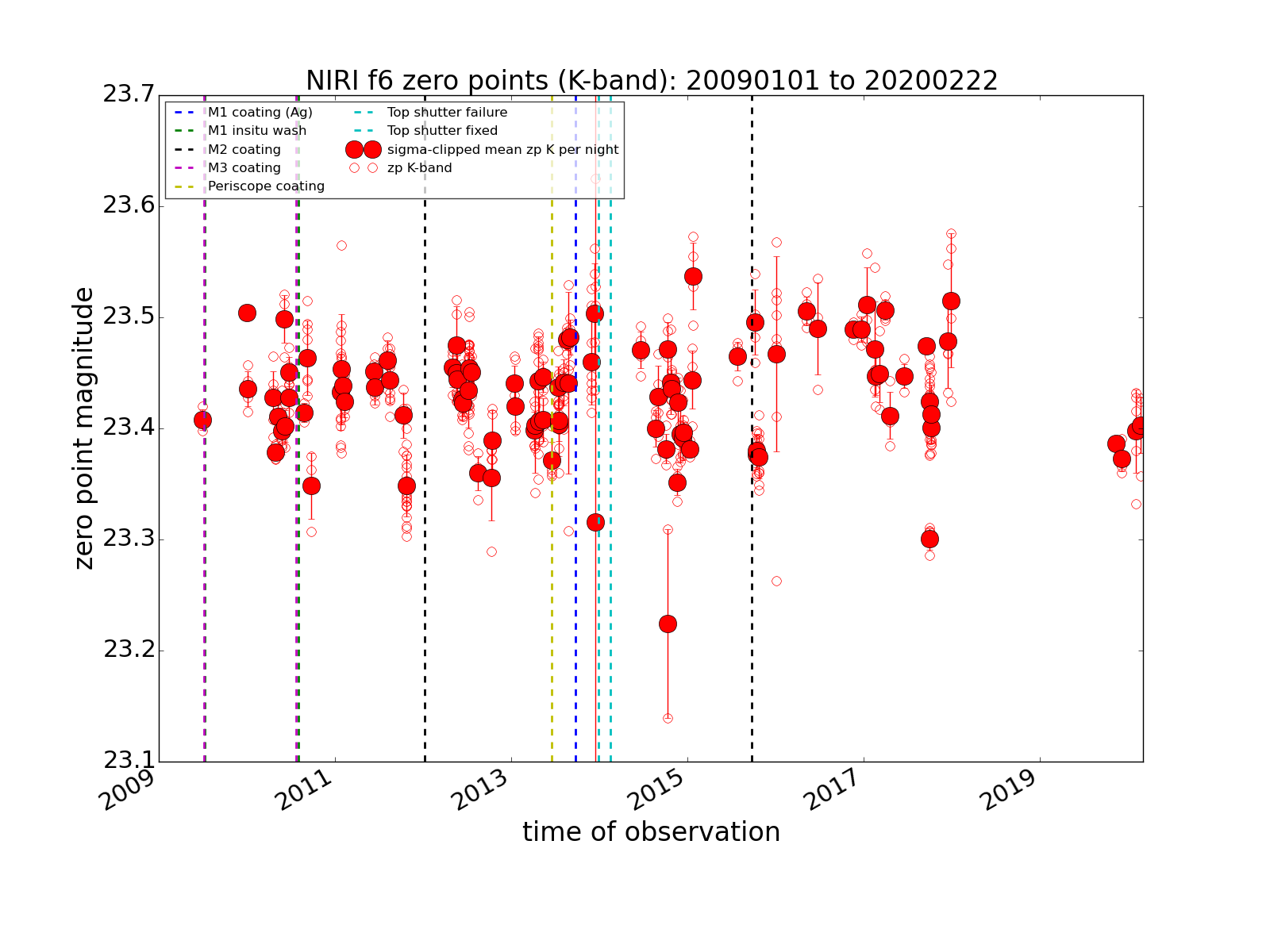
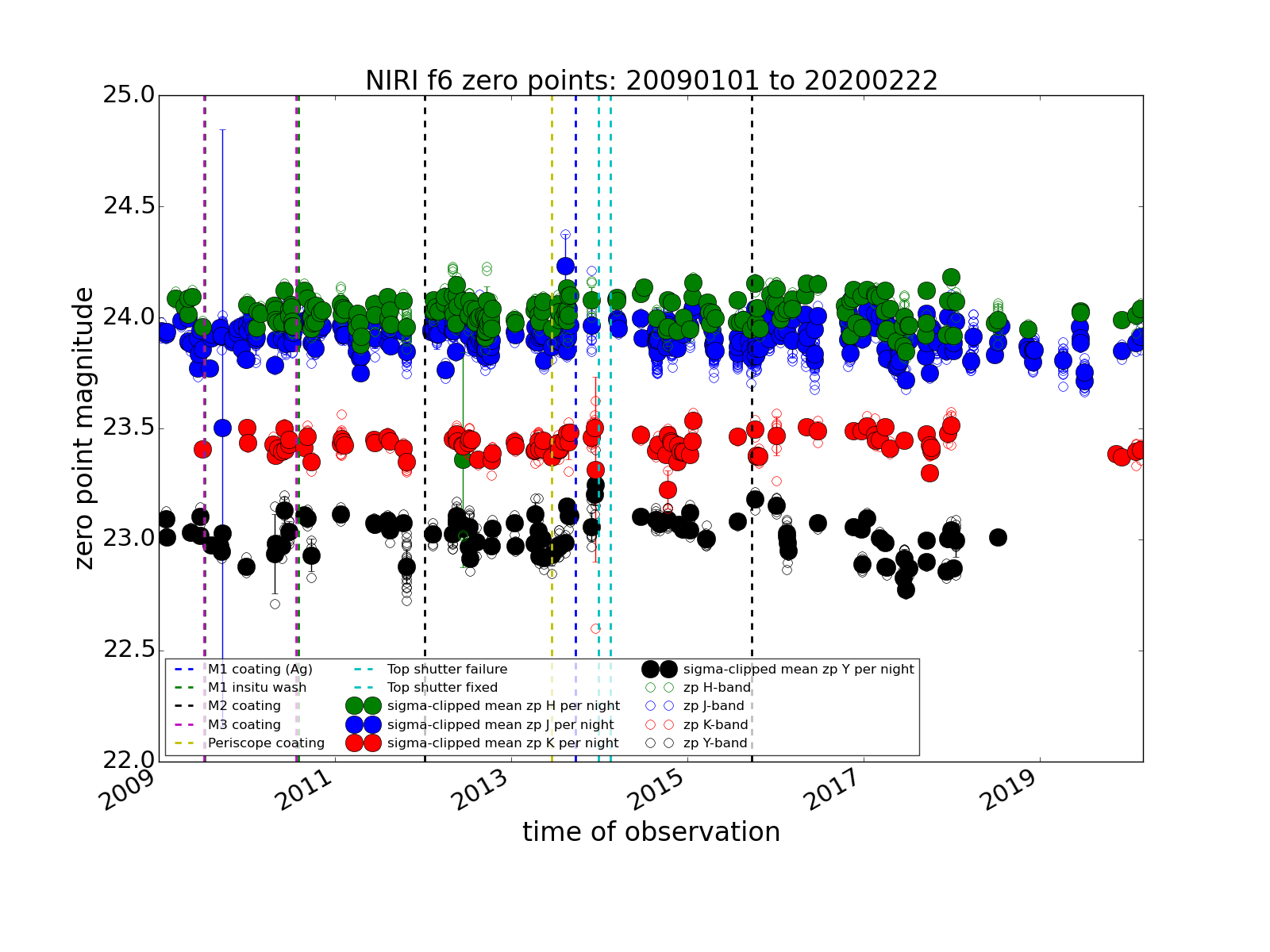
Imaging throughput for NIRI is tabulated in the form of photometric zero points for JHK bands. Zero points are given by
mstd = mzero - 2.5 log (N/t) - k (AM -1)
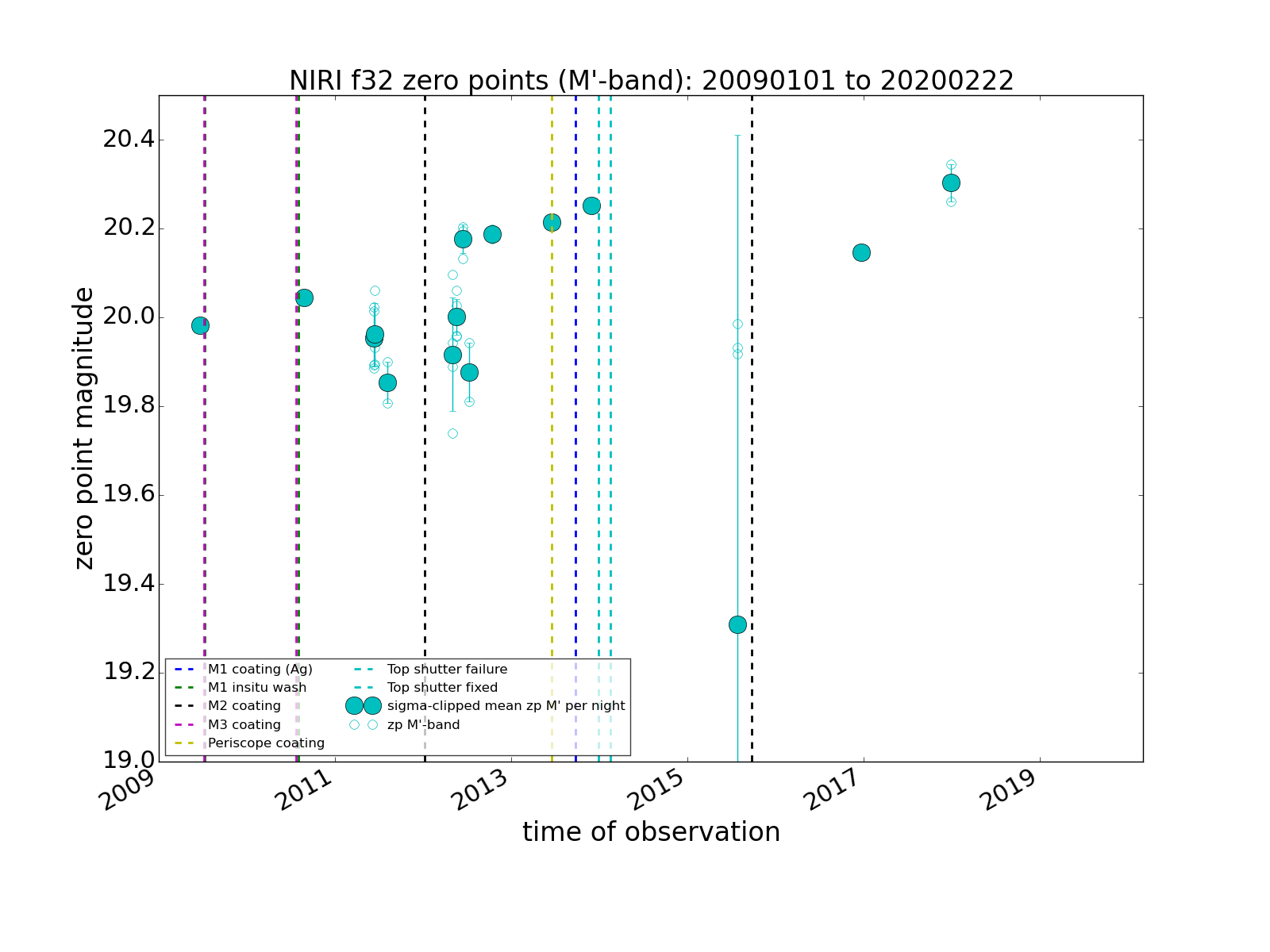
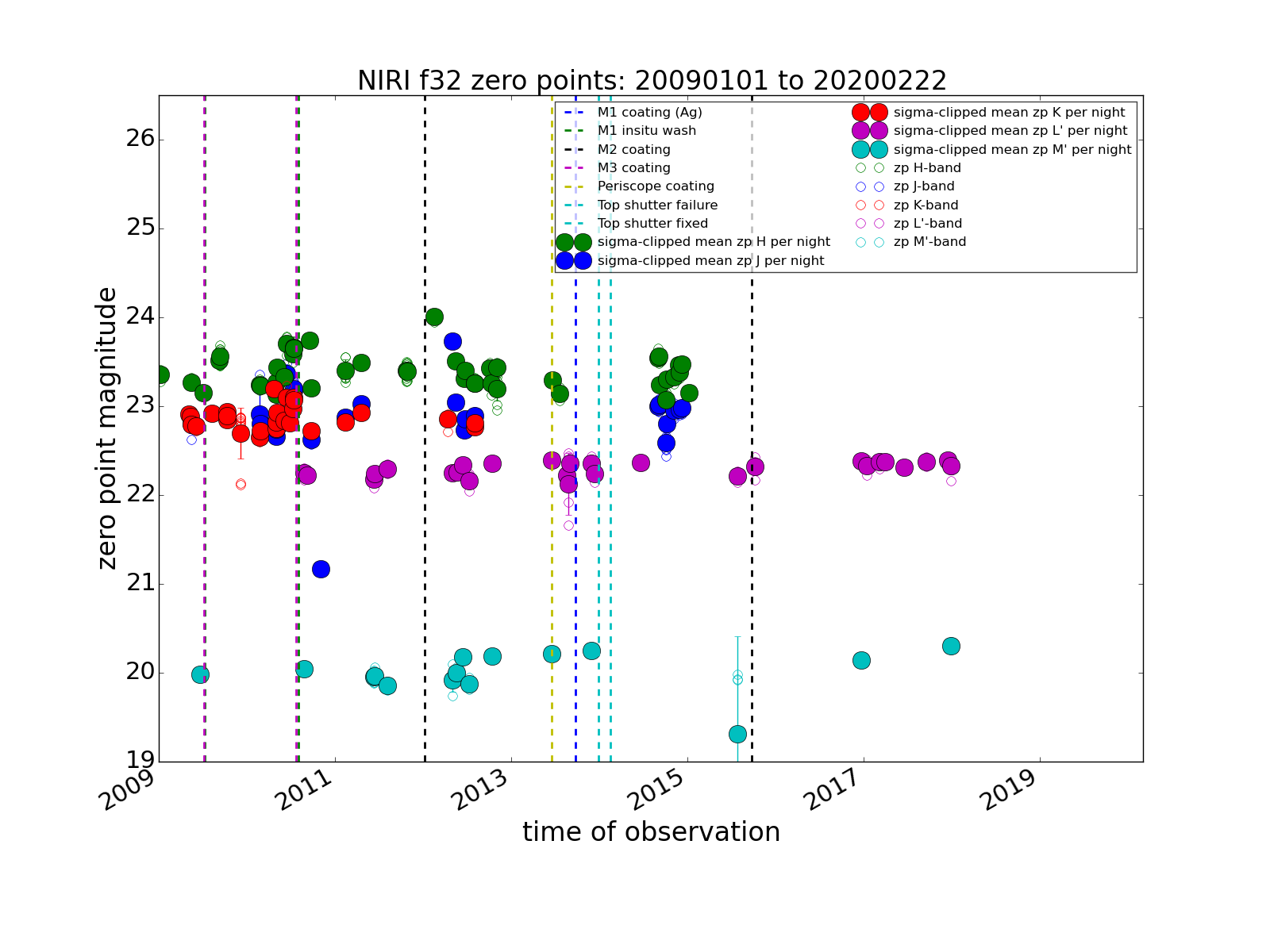
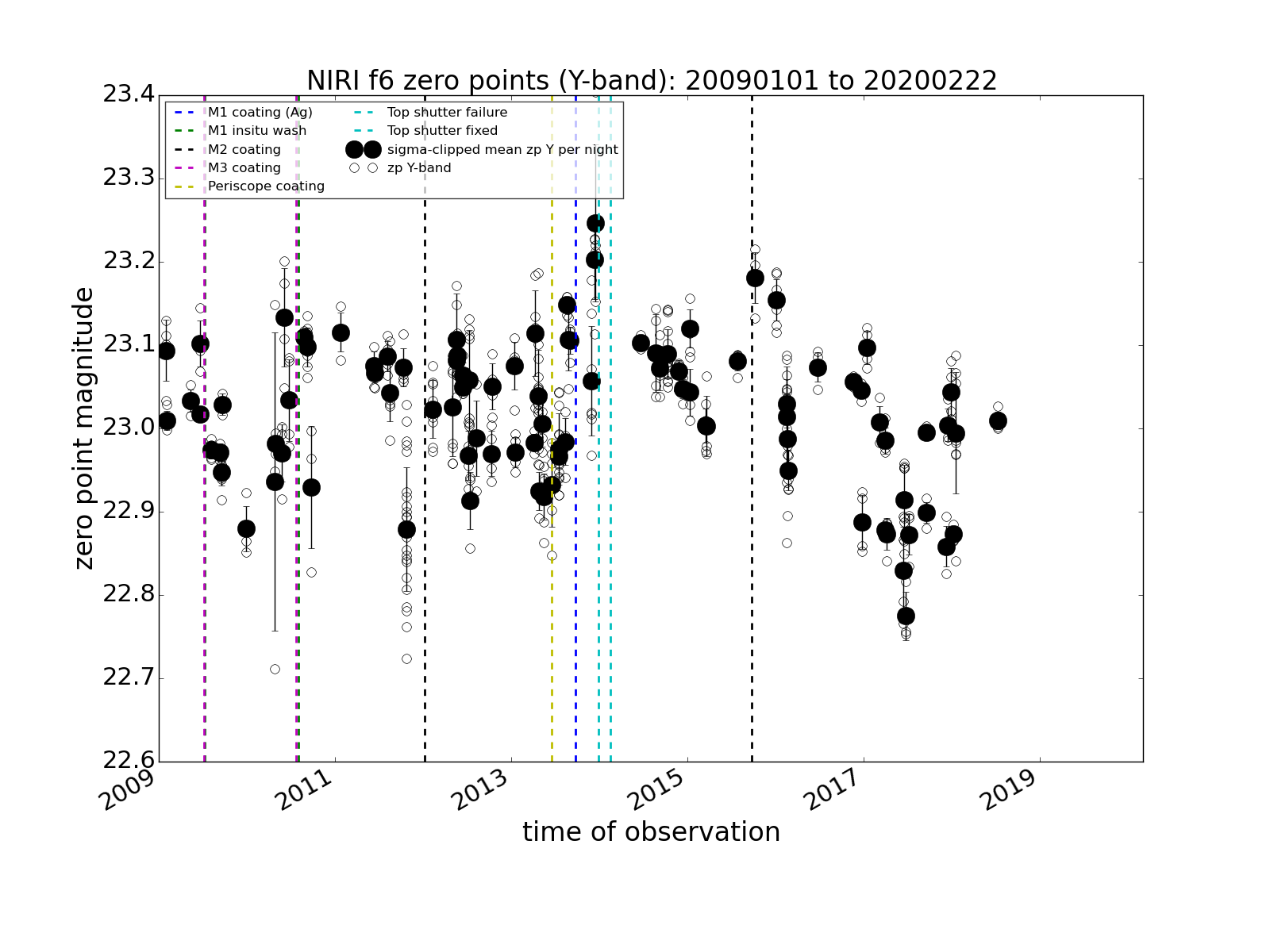
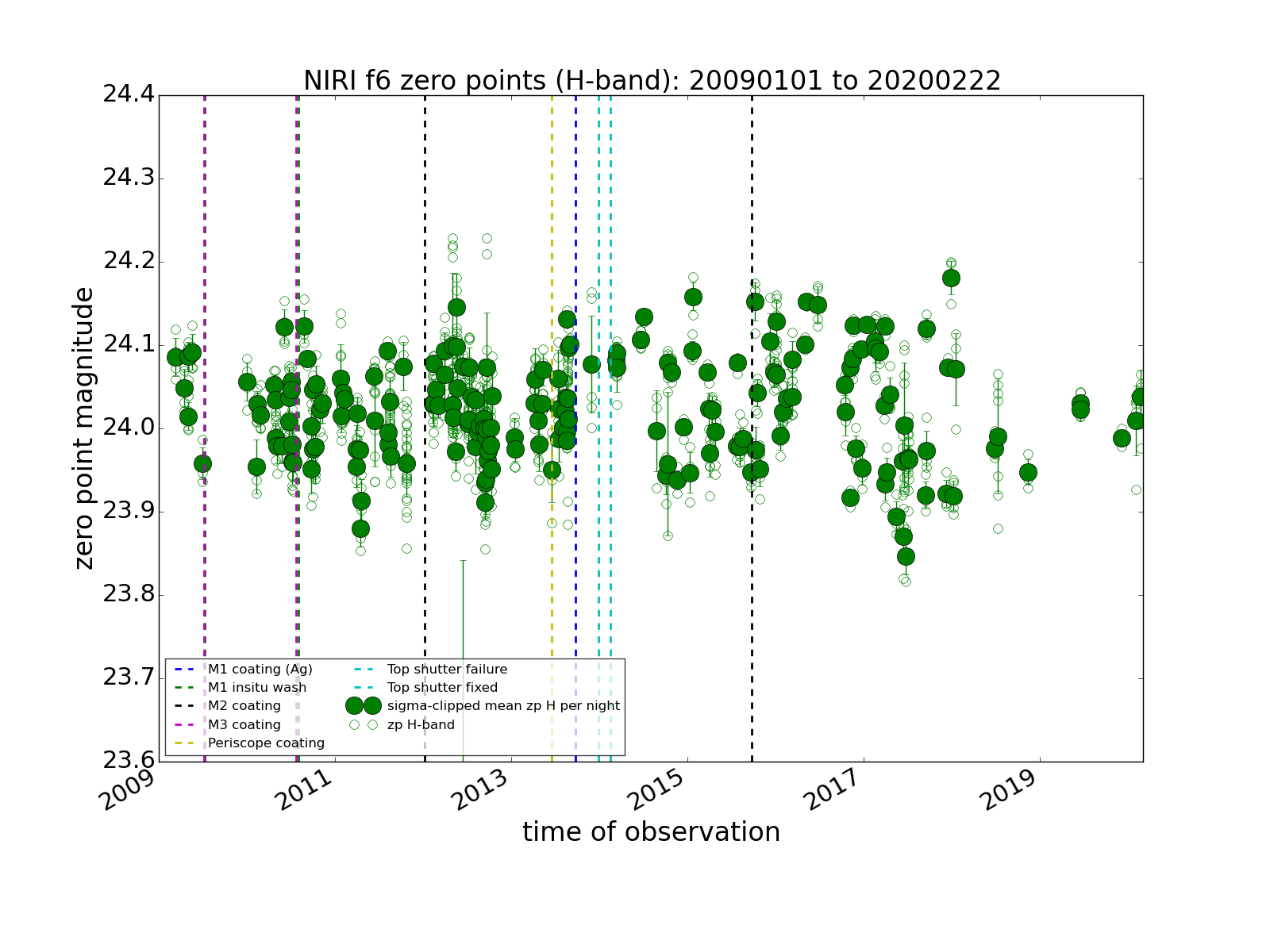
where N is the background-subtracted number of ADU within the aperture, t is the exposure time, AM is the airmass. The extinction coefficients k were taken from Leggett et al. (2006). Magnitudes were measured within an aperture that is equal to 4 times the FWHM of the images, so they are insensitive to seeing variations. The data files and plots below contain all data since the beginning of 2009 run through an updated instrument monitoring pipeline which was introduced end of 2017 to replace the one running at that time developed in 2009 (see here for more details). The new pipeline takes now non-linearity effects into account so the zero points differ slightly from the old ones. It can now also handle M' and L' band. The data files now come in two flavors. For each filter the pipeline calculates a nightly average (as done by the old pipeline), but it also provides the full results, i.e. for each individual image all the relevant information are listed (see here for more details). More information can also be found on Gemini's NIR photometric standard stars page. For the data, follow the links in the table below:
| Camera | Band | Individual Measurements | Plot |
| F/32 | J | nightly averages | Click |
| F/32 | H | nightly averages | Click |
| F/32 | K | nightly averages | Click |
| F/32 | L' | nightly averages | Click |
| F/32 | M' | nightly averages | Click |
| F/32 | all | full results | Click |
| F/6 | Y | nightly averages | Click |
| F/6 | J | nightly averages | Click |
| F/6 | H | nightly averages | Click |
| F/6 | K | nightly averages | Click |
| F/6 | all | full results | Click |