- PIO
- Sciops
- Gemini Home
- Telescopes and Sites
- Science Visitors at Gemini
- Observing With Gemini
- Instruments
- Retired Instruments
- NORTH
- ALTAIR
- GMOS
- GNIRS
- NIFS
- NIRI
- SOUTH
- FLAMINGOS-2
- GeMS
- GMOS
- GPI
- GSAOI
- NICI
- VISITING
- Visiting Instrument Policy
- DSSI Speckle Camera (North)
- TEXES (North)
- RESOURCES
- Integration Time Calculators
- Adaptive Optics
- GCAL
- Magnitudes and Fluxes
- Near-IR Resources
- Mid-IR Resources
- Observing Condition Constraints
- Performance Monitoring
- SV/Demo Science
- Future Instrumentation
- Queue and Schedules
- Data and Results
- Helpdesk
- Statistics
Change page style:
GNIRS Sensitivity
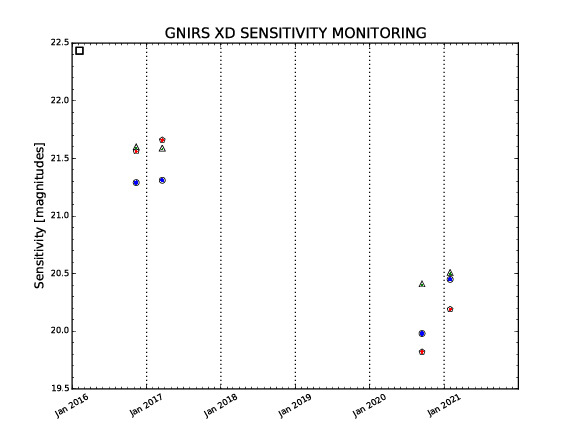
The sensitivities reported for GNIRS reflect the magnitude of an object that would provide a signal-to-noise ratio of 1 for an hour of integration time (SN1 hr). To calculate the signal-to-noise ratio, the signal is determined from telluric standard stars observed with requested photometric (CC50) IQ20 to IQ70 conditions, while the noise is determined from a subtracted pair of long-sky frames. The sky frames used have an integration time (T) > 500 seconds, observed within temporal proximity of the telluric standard, and are observed under the same photometric conditions.
The signal is found by taking the mean over the telluric's spectrum (S) with a circular aperture area defined by the guiding source. For AO and P2 guiding, apertures are fixed at 0.3'' and 2.5'', respectively.
With a subtracted pair of long-sky frames, on an area of sky generally free of sky lines and artifacts, noise (N) is determined by multiplying the average standard deviation in the background counts by the square root of the aperture area used to find the signal.
| SN1 hr = | S * (3600 / Ttelluric)
N * (3600 / (2 * Tsky))1/2 |
To find the sensitivity, the signal-to-noise ratio (SN1 hr) is converted to a magnitude and added to the Simbad magnitude (MSimbad), in the corresponding waveband, of the standard star:
| Sensitivity = 2.5 * log(SN1 hr) + MSimbad . |
Sensitivity measurements for telluric standard star observations, taken at the central wavelength of each band, are reported below.
Plots
 GNIRS-XD |
 GNIRS-LS |