|
Hokupa'a-85 Introduction |
Hokupa'a-85 (or H85) is a natural guide star (NGS), curvature-sensing adaptive optics system (AOS) built by the University of Hawaii. It gives near diffraction-limited resolutions in the K and H bands. We have arranged for its use as a loaned instrument on Gemini South. A 1-5µm near infrared camera (ABU) is located at the exit focal-plane.
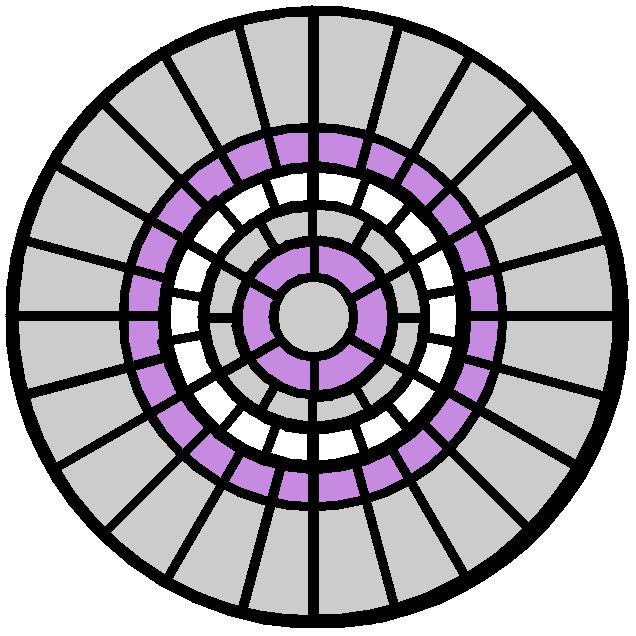
Hokupa'a is based around an 85-element curvature wavefront sensor (WFS) and bimorph mirror. In brief, Hokupa'a makes wavefront measurements using pairs of extra-focal images whose differences are proportional to the curvature of the wavefront. A lenslet array and a set of avalanche photo-diodes (APDs) define the sub-elements in the measurement. A deformable mirror (DM) with an arrangement of actuators matched to the wavefront sensor is shaped into a conjugate of the measured aberrations to correct the wavefront. The corrected light with wavelength shortward of 1µm is sent to the WFS while light longward of 1µm is sent to the science instrument. See the Performance and Use section for more details.
The requirement of a wavefront reference source for the adaptive optics system leads to several important considerations in the selection of targets for the AOS. Foremost, there must be a suitably bright point-like source within 30 arcseconds of the science target. This requirement is set by the acquisition field of the WFS acquisition steering mirror. In addition, this source must be within the WFS's 4 arcsecond diameter field of view and must have some contrast (i.e. be approximately point-like). The actual magnitude limit depends on the degree of correction required; for very bright guide stars the system performance is limited by the number of actuators rather than photon noise.
Hokupa'a-85 is intended to deliver images with near diffraction-limited resolutions at 2.2 microns in 1" or better seeing. Under favorable seeing conditions, FWHM of about ?% of the diffraction limit can be in the J-band. The actual delivered performance of the system depends strongly on several factors: the guide-star characteristics, the intrinsic spatial and temporal properties of the atmosphere, telescope wind shake, and so forth. For further information, see the Performance and Use section.
The corrected output beam of Hokupa'a-85 is fed at f/32 to a near-infrared camera, ABU. With ABU, Hokupa'a-85 provides a fixed plate-scale of 21.5 milliarcseconds per pixel (diffraction limit is critically sampled at H).
From here the first place to go is the Performance and Use page. If you're new to adaptive optics, Hokupa'a-85 or ABU you may want to check out the AO Primer (see also the tutorial by Andrei Tokovinin), Hokupa'a-85 Basics, and ABU Basics pages. Proposal writers should check out the Proposal Checklist for things to consider including in proposals for time with Hokupa'a-85/ABU.


Last update 19 July 2004; Bob Blum