|
Hokupa'a-85 Guide Star Requirements |
The wavefront sensor ``star'' can be either the science object of interest or a nearby bright star. The criteria for using the science object as a wavefront reference is that it has a surface brightness profile which is point-like (although objects of angular extent up to 1.5 arcsec or more may work) and the flux contained within the central 2 arcsec is sufficiently bright.
The most critical guide star consideration in the performance of Hokupa'a-85 is the brightness of the wavefront reference star. Full correction is given for R ~12-13 mag with a 50% Strehl degradation at R~15. Some correction is expected to R~17 mag, but these corrections will be minimal under all but the very best seeing conditions. Performance predictions are available in the Hokupa'a-85 Performance Calculations page.
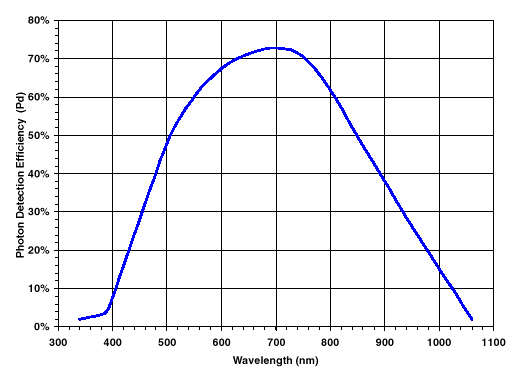
The wavelength response of the wavefront sensor channel is basically limited by the response of the APD's silicon. The following plot shows the wavelength sensitvity of the APDs as given in the EG&G SPCM-AQR Series Datasheet. This is not a scan of the throughput of to the WFS and is only given to give a sense of the wavelength sensitivity. The APDs in H85 are now manufactured by Perkin Elmer (APDs from both manufacturers are currently used by H85). The total throughput to the WFS is approximately ??%.
The brightest guide star that can be used is set by the maximum count rate in the APDs and the strength of the neutral density filters in front of the Hokupaa wavefront sensor. The maximum APD count rate is 1000 photon counts/cycle. The following table lists the available neutral density filters in Hokupa'a-85. Hokupa'85a has been used in engineering tests on stars as bright as R~? mag with the ND? filter.
| Filter | Strength |
|---|---|
| ND1 | Opaque |
| ND2 | ? magnitudes |
| ND3 | ? magnitudes |
| ND4 | ? magnitudes |
| ND5 | ? magnitudes |
| ND6 | Clear |
Differences in the wavefront aberrations along different paths through the atmosphere limit the field of view over which the correction of the adaptive optics system is valid. This translates into a variation of the PSF (Strehl and FWHM) across the field of view. How large an effect this is depends strongly on the wavelength and seeing conditions (mainly determined by the Fried parameter, r0 where the seeing FWHM ~ wavelength/r0). Performance predictions are available in the Hokupa'a-85 Simulations page.
Hokupa'a-85 can acquire an AOWFS star as far as 30" off-axis.


Last update July 20, 2004; Bob Blum