We briefly present the basic AO principles and how anisoplanatism affect the off-axis
image quality. The basic principles of MCAO are then presented together with the
parameters of the Gemini MCAO.
A overview article can also be found
here.
Summary
By compensating the atmospheric turbulence in a 3-D fashion, MCAO provide a uniform image
quality ("diffraction-limited" in the near-IR) over a much wider field than regular
AO (one to two arcmin in diameter depending on IQ criterion).
This is particularly important to tackle number of astrophysical problems that require
relatively wide field of view or very accurate photometry.
MCAO also solves the cone effect associated with the use of laser guide stars. The
average sky coverage in H band is approximately 50% over the whole sky.
Anisoplanatism, Cone effect and Sky coverage: The plague of Classical AO...
An Adaptive Optics Primer can be found in this very site
(AO primer page).
Althought it is a rather
new technique, AO has been and is continuing to
provide a harvest of new scientific results. All the major large telescopes
have recognized its unique and inovating value. However, its widest application
has been restricted because of several well-identified problems.
Limited Anisoplanatic Angle
The wavefront sensors measures the phase perturbations integrated along
the line of sight. The atmosphere is 3-dimensionnal, and the perturbations
occur everywhere between the telescope and the highest turbulent layers, typically
at 10-15 km above site. In a direction different from the direction of the guide
star, because the beam is going through another part of the turbulence volume,
the integrated phase perturbation is going to differ. If the compensation
is the best at the guide star ("on-axis"), it degrades as soon as one looks off-axis.
Of course, how fast this degradation is depends on a number of parameters,
such as for instance the vertical distribution of turbulence (the so called
Cn2 profile), the wavelength and the order of the AO system (how many modes
are corrected). For low to medium order systems currently in operation,
in sites such as the Chilean sites or Mauna Kea, typical values for
the isoplanatic angle (defined here as the angle from the guide star at which
the Strehl ratio has fallen by 50% with respect to its value at the guide star)
are 20'' in J band, 30'' in H and 40'' in K band, and gets even smaller for
the new generation of higher order systems on current large telescope.
The isoplanatic angle varies
as the wavelength1.2 and as the airmass1.6.
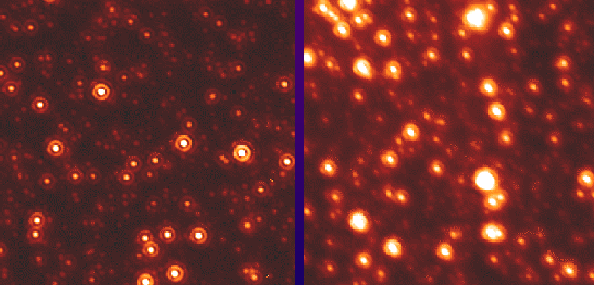
The images below present an example of anisoplanatism. These two images
are extracted from a 35''x35'' K band image taken with the infrared camera KIR and
the AO system PUEO at the Canada-France-Hawaii Telescope. They are separated by
approximately 30'' (center to center). The difference is striking: Airy rings
are almost completely gone, the loss in Strehl is of a factor of 2 (47% left image; 24% right image)
and the FWHM goes
from 0.140'' to 0.185''. This is a typical result for an object at 2 airmasses,
from the few periods statistics that we have, and illustrates the importance of resolution
and Strehl ratio: For this kind of objects (which probably covers most of the stellar
population studies), not only the Strehl ratio is important to increase the signal
to noise ratio, but also the angular resolution, that plays an important role
in crowded field.
Sky Coverage
AO compensation can only be obtained
in the vicinity of relatively bright stars (R approx. 15).
Only 5% of the sky is accessible for diffraction lmited imaging with AO
(typical value for an acceptable degradation of the compensation performance).
This severe limitation lead to the idea to use Laser Guide Stars (LGSs).
To date, the most promising
laser guide star concept uses the fluorescence of Sodium atoms in the mesosphere,
a layer well known from atmospheric scientist that lies between 90 and 100 km
above see level. This concept has been validated by a couple of experiment around
the world (Calar Alto in Spain and Lick Observatory) that have closed AO loop
using sodium beacons.
Cone Effect
However, LGSs do not come without limitations. The major
one is that, the source being at a finite range, the return beam does not
probe exactly the same volume as the beam coming from an astronomical object
at infinity. One can easily visualise that this geometrical effect is going to be more
severe when the telescope diameter increases. An order of magnitude for
the Strehl ratio loss is 50% at 1 micron for a 8-m telescope and a typical
Chile or Mauna Kea vertical turbulence profile. This is a major limitation
for current large telescope, where it prevents the extention of
laser guide star AO in the visible part of the spectrum. LGS AO, therefore
large sky coverage AO, is therefore unthinkable on the next generation
of giant telescope, unless a solution is found to this problem.
... and MCAO, The Cure
MCAO solves all of the above problems. By using several guide stars and several
deformable mirrors, a uniform image compensation can be achieved on a field
significantly larger than the natural isoplanatic patch. This technique can
use indifferently natural or laser guide stars. The very essence of MCAO -by
probing and correcting a large turbulent volume- also takes care of the cone
effect when using laser guide stars, which increases the compensation
performance on current 8-m telescopes and open the gates for the application
of LGS AO on giant telescopes. The wide field (over an arcminute at
the diffraction limit in the current design of the Gemini MCAO) opens new
frontiers for science discoveries, which are still unexplored (therefore
undefined, which is why the Gemini astronomical community is currently
working to define the MCAO science case).
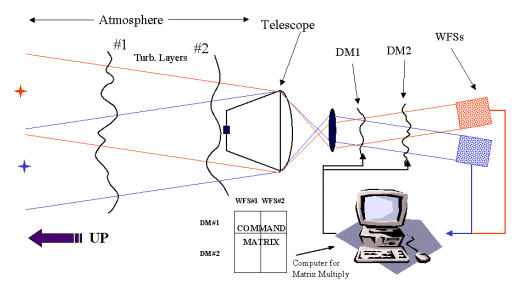
The figure above presents a sketch of a MCAO system. In this figure, two
wavefront sensors (WFSs)
are looking at two off-axis guide stars. Perturbations at different altitudes
will be seen with different shifts between the two sensors (for a more
lengthy elaboration on this, see
this page).
The information from both sensors is processed by a central processing unit,
which feed them to a reconstructor that computes the command to apply to a
set of deformable mirrors to minimize the WFS error signal. The 3D turbulence
content is never explicitely reconstructed in this process, avoiding the extreme
sensitivity to noise of the latter techniques. In fact, MCAO's sensitivity to
noise is very similar than classical AO, which has the happy consequence than
the guide star brigthness requirements are the same (e.g. laser power).
A collection of more complete articles on the MCAO principles, limitation
and performance can be found in the Gemini AO archives.
The table below present the main characteristics of the Gemini MCAO
system. More details on the instrument itself and on the expected performance
are provided on the following pages in this site.