|
Gemini Adaptive Optics Program |
 |
Overview of the Gemini AO Program |
This document presents a brief overview of the reshaped Adaptive Optics (AO) Program
for the GEMINI telescopes. This program includes both Mauna-Kea and Cerro Pachon AO
facilities. We present a summary of the current status of the program, and introduce its
proposed evolution. We also evaluate the impact on and adequacy with the instrument
program.
The current AO program at GEMINI comprises Altair, a NGS/LGS adaptive optics system for the Mauna Kea Telescope. The construction of Altair is underway and proceeding well at the Hertzberg Institute for Astrophysics, Victoria, Canada. A request for proposal for a 10-20 watts sodium laser to be used with Altair on Mauna Kea is ready to be distributed.
The University of Hawaii's AO system, Hokupa'a, was installed on the telescope early June this year and delivered exquisite images for the MK telescope dedication. An upgrade to 85 elements is planned sometime in 2000. Hokupa'a will be available on the MK telescope until Altair's commissioning in 2001.
After consultation with the GEMINI AO and science communities at an AO workshop held in Hilo in April '99, the GEMINI AO and instrumentation groups came up with a proposal for the Cerro Pachon AO facility capability. Motivated by the very strong competition with other observatories, the requirements of the science programs as laid in the Abingdon report and longer term issues such as competitiveness in the NGST era and technology development, a multi-conjugate adaptive optics system (MCAO) is proposed for CP as the key element in the GEMINI AO program. This system will basically deliver a uniform AO compensated image quality over a nearly 2 arcmin field of view, with on-axis performance of the order of or better than Altair's. It is expected that this system, in conjunction with a well thought out instrumentation suite, will address a significant fraction of the NGST science programs 4 years prior to the NGST launch. As a result of the April CP forum and a request from the GEMINI board of directors, a feasibility study for the MCAO system has been carried out. This 60-page document addresses the science drivers of such an instrument, a theoretical analysis assessing performance, computing and control issues and includes a proof-of-concept optical and mechanical design and an early management plan, with schedule and cost. Because of its cost, the development of this MCAO system will have some impact on the instrumentation program. This is addressed in the feasibility study document.
Following the success of Hokupa'a at GEMINI north, we propose to duplicate its upgraded version, Hokupa'a-85 actuators, for use at the Cerro Pachon telescope in the period from operational hand-over to the availability of the CP MCAO system in late 2003. Hokupa'a-85 would be coupled to a commercially available low-power sodium laser, which would provide the GEMINI science community with a 2+ year window of unchallenged capability in the southern hemisphere with a very adequate level of performance. Hokupa'a-CP would be a visitor instrument. The duplication of Hokupa'a-85 is dependent on the funding of a NSF proposal that was submitted by the UH-AO group in late August.
We believe that the proposed program addresses most of the requirements of the
GEMINI science mission, as defined in the top science requirements and the Abingdon
science programs. It will put the GEMINI science community at the very forefront for
several years, and will still be competitive (near IR spectroscopy) in the NGST era.
Adaptive Optics has been a very high priority at GEMINI since the very beginning. "Outstanding image quality" is one of the key requirements, and AO has always been seen as the way to achieve this goal. The Abingdon report shows clearly that AO is needed for most of the science programs targeted by the GEMINI user's community. An AO program was outlined relatively early in the project, including provision for facility systems both at MK and CP.
Altair. Only the MK AO system has been defined in detail; it is the AO system Altair (ALTitude conjugated Adaptive optic system for the Infrared Red). The Altair contract was signed in 1997 with the DAO, Hertzberg Institute for Astrophysics, Victoria, Canada. Altair has passed successfully the conceptual design stage, preliminary design and critical design reviews (CDR in 02/1999), and is now being fabricated.
Altair LGS retrofit. The use of laser guide stars (LGSs) greatly increases the sky coverage of an AO system, and is necessary to address most of the science programs as defined in e.g. the Abingdon report. It was decided to fit Altair with a LGS. This encompasses upgrading Altair, specifically by building a LGS dedicated wavefront sensor (WFS) and various interfaces to the GEMINI-built LGS launch system. The Altair team has already started working on these issues. A contract will be signed shortly with HIA. The statement of work is already prepared and should be formalized within a few weeks. The Abingdon report recommended upgrading Altair to a LGS AO system, and this project has been approved as part of the ongoing instrumentation program.
Altair's Laser. Studies were made earlier this year at GEMINI to specify the Altair laser requirements. This resulted in a request for proposal to be released October 1st, 1999. Several vendors have already expressed interest in responding. The requirements in power for this laser vary from 7 to 21 watts, depending on the laser pulse format.
Early 1998, the possibility arose to use the UH AO system Hokupa'a early after the MK telescope first light. This was motivated by an early access to an AO capability before the facility instrument Altair was available, and was also expected to be a very useful tool during telescope commissioning (it is). A memorandum of understanding was signed between UH and GEMINI in late 1998. Hokupa'a went through some modifications early this year to make it compatible with the F/16 input beam and the mechanical interface with the Instrument Support Structure (ISS). A new deformable mirror also was retrofitted. Hokupa'a was installed in late May, and obtained nearly diffraction images only days later, in time for the dedication. Some of these images are shown below. The performance is fully compatible with the expectations as derived from the numerical simulation codes available at both UH and GEMINI. AO compensated images with Strehl ratios of 15-30% and Full Width at Half Maximum (FWHM) of 70 to 100 milliarcsec were obtained regularly during the pre-dedication run, with seeing values of 0.7 to 1 arcsec. Hokupa'a is going to be upgraded next year to accommodate an 85 actuator deformable mirror and a 85 sub-aperture sensor. This will be done under the current Hokupa'a NSF grant and should have minimal impact on operation. The expected performance of the Hokupa'a-85 is given in the table 1 below. The quoted Strehl ratios include only the contribution of the atmospheric turbulence, as compensated by the AO system. It does not include residual static aberrations from the telescope or the instrument (e.g. the Quirc static aberrations currently reduce the Strehl ratio by about 40% in K band). Hokupa'a-85, with Quirc, will be available for use by the GEMINI communities during early operational use of GEMINI North, prior to arrival of Altair.
Seeing |
J band Strehl ratio |
K band Strehl ratio |
0.45'' |
50% |
80% |
0.65'' |
25% |
62% |
Table 1: Expected performance of Hokupa'a-85 (AO only)
The AO group at GEMINI has recently been substantially reinforced. It is now including Mark Chun (scientist in charge of MK AO operation and the MK LGS program), Céline d'Orgeville (engineer in charge of the laser developments and operations), Brent Ellerbroek (AO program manager) Ralf Flicker (PhD student) and Francois Rigaut (AO program scientist) as full time members. Corinne Boyer (software engineer), Jacques Sebag (system engineer), Jim Oschmann (GEMINI project manager, acting as optical designer and system engineer for AO), Chris Carter (control engineer) and David Montgomery (mechanical engineer) have dedicated and/or will dedicate a significant fraction of their time to AO efforts.
Figure 1: The globular cluster NGC6934 imaged in
the visible with the GEMINI acquisition camera (left), and with the Quirc IR camera and
the UH-AO system Hokupa'a (right) is one example of the outstanding image quality already
obtained at the Gemini telescope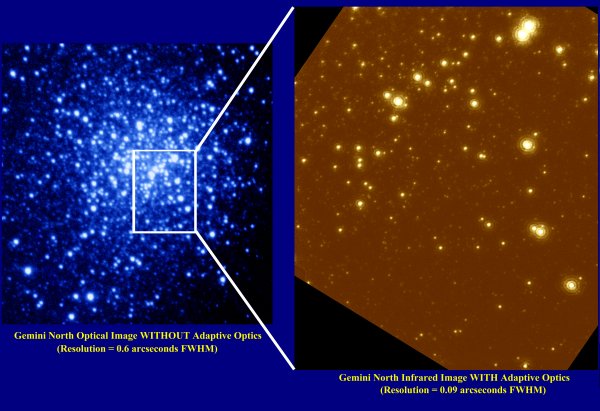
High spatial resolution has been identified by most of the leading observatories as one of the master keys needed to answer the most important astrophysical questions in the next decades.
The European VLT has made major investments in AO, working in this field for more than 10 years (the instrument COME-ON has been in operation since 1989 at the ESO-La Silla 3.6-m telescope). The VLT-NAOS AO system commissioning on VLT-UT1 is planned for mid 2001 (14x14 sub-apertures Shack-Hartmann system). An integral field unit, with an integrated AO curvature system, is also planned for 2001, and a major effort is being devoted to medium order, interferometry-dedicated AO systems (2 of these are funded and in design phase). The ESO Laser Guide Star program has recently been delayed as a consequence of budgetary issues, but our understanding is that a LGS should be ready for use with NAOS in 2003.
The Keck observatory has also adopted a rather aggressive approach to AO. Their AO program began in 1994 and since December '98, within the first night of operation, Keck has had a working high order AO system (20x20 sub-apertures Shack-Hartmann) on Keck-II. They have funding for a second system to be installed on Keck-I. Although not yet fully optimized for automated nighttime use atop Mauna Kea, a laser has been at Keck for the last 10 months. This laser could be used on the telescope in conjunction with their AO system in several months.
Subaru also has an AO program, although more modest that VLT's or Keck's. The Subaru AO system, a 37-actuator curvature-based system, has already been tested on a telescope in Japan and installation on the 8-m telescope is planned for around the end of this year.
Although a budget is allocated to it, the CP AO facility is not yet defined. To take advantage of the community expertise, GEMINI organized a workshop on the CP AO facility system, held in April 1999 at the GEMINI headquarters. Members from the international AO community and GEMINI science community were invited to participate and present their thoughts/proposals for the CP AO facility. The response was overwhelming, with around 40 participants. A significant number of attendants were interested in participating in the subsystem design/fabrication, but no group proposed to design the entire system.
As the end of this workshop, a review panel formulated recommendations to the director of the IGPO on how to proceed for the CP AO facility. The review panel members were Mark Chun (IGPO), Roberto Ragazzoni (Padova Observatory), Francois Rigaut (IGPO-Chair), Chris Shelton (Keck), Doug Simons (IGPO), and Peter Wizinowich (Keck). The recommendations are as follows:
The IGPO has released an open request for proposals for a laser system for the Mauna Kea Laser Guide Star system and is currently pursuing ways to implement well-engineered facility-class laser systems.
Figure 2 present a summary of the proposed AO program. Altair, the 10WLGS (aka MKLGS or Altair's LGS) and MK-Hokupa'a have been described above in section 1. The additional elements of the proposed AO program includes the facility system for Cerro Pachon to be ready end of 2003 and a duplicate of Hokupa'a, to be used at Cerro Pachon from 2001 until the commissioning of the above mentioned facility system.
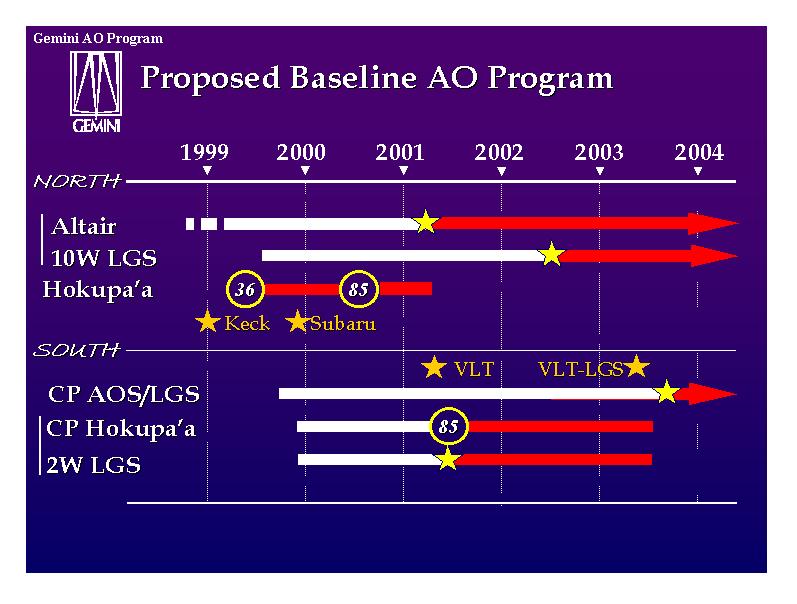
Figure 2: Layout of the AO program at MK and CP. White bands
correspond to off-telescope work (design, manufacturing, integration and tests), darker
bands correspond to the commissioning period and general availability to the community.
The stars mark the installation on the telescope
Following the recommendations of the April’99 CP workshop review panel and a request from the GEMINI board of directors, a feasibility study for the multi-conjugate AO (MCAO) has been done at IGPO. This feasibility study discusses the rationale of building such a system, viewed in context. It presently includes a sub-sample of the science case, theoretical analysis of MCAO control, numerical simulation assessment of the performance, engineering feasibility, a proof-of-concept optical and mechanical layout, assessment of the computing issues and a management plan including schedule and resource needs. At the conclusion of this feasibility study, we have identified no fundamental, theoretical or technological limit that would prevent implementing a MCAO system. This study is available at the GEMINI web site (feasibility study document). We refer the reader to this feasibility study for more details on the MCAO system. We give here only a short summary of the discussions in the feasibility study.
2.3.1.1 Proposed MCAO system
We propose to build a high performance, 2 arc minutes field-of-view AO system with uniform PSF quality over the entire field-of-view.
The principles of MCAO are described in some details in the feasibility study. The basic idea is to compensate for the turbulence in a 3-dimensional fashion, by having several deformable mirrors conjugated to different altitudes, instead of the single ground-conjugated deformable mirror in classical/existing AO systems. By using this technique, MCAO is able to reach on-axis NGS AO type performance, with a uniform PSF, over 1-2+ arcmin field of view.
The basic advantages of an MCAO system with respect to more conventional NGS or LGS systems are:
2.3.1.2 Rationale
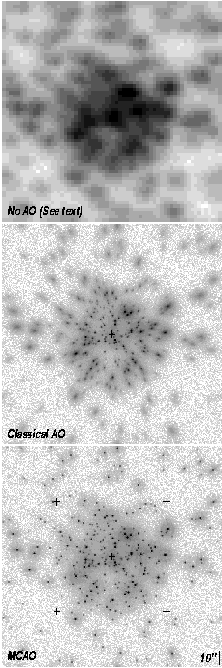
Figure 3: An example of NGS MCAO capability. Simulated stellar field with 320 stars, showed without AO, with a classical single guide star/deformable mirror AO and with a 2 deformable mirror/5 guide star MCAO. The wavefront sensors have 8x8 subapertures. The field of view is 165 arcsec on the side, the wavelength is 2.1 micron. The telescope aperture is 8-m. The natural seeing is 0.7 arcsec at 550 nm. Note that each star has been blown up by 15x to be able to better see the PSF variations. Because of this, the crowding looks worse than it actually is (especially on the No-AO image). The guide stars are not shown on these images, but their positions are marked by crosses.
2.3.1.3 Engineering feasibility
Implementing a MCAO system is more complex than a conventional AO system. However, for an 8-m class telescope all the required technologies are available except the laser systems. The minimum requirements for each laser are no greater than those for the MK-LGS laser system for Altair. The principal difficulties are the opto-mechanical design, the implementation of multiple laser guide stars, and the controls. With appropriate design trades these issues can be overcome. Our feasibility study presents a proof-of-concept opto-mechanical design only slightly more complex than Altair, a simple laser launch configuration, and a control system with requirements similar to current high-order AO systems. For example, a MCAO system with 3 deformable mirrors of order 12x12, 14x14, and 16x16 can be fit into the current GEMINI space requirements, driven with commercially available processor electronics and would require four laser guide stars sensed with a single, 128x128 pixel low-noise CCD detector.
2.3.1.4 Baseline instruments
To take advantage of the image quality and field of view delivered by MCAO and address
most effectively the science programs defined in the Abingdon report, three classes of
instruments can be defined:
The near term IRMOS is currently part of the ongoing instrument program as
IRIS-2g/Flamingo-II. The wide field imager is not. A deployable IFU IRMOS is part of the
ongoing instrumentation program, but is not planned to be offered before 2005-2006.
The VLT-NAOS should be on the telescope by 2001. GEMINI or its partners can not develop a facility system for CP by that time. Even simple duplication of the Altair system could not come on line before 2002 at the earliest. To fill this gap, and exploit the success of Hokupa'a at GEMINI north, we propose to duplicate its upgraded version, Hokupa'a-85, for use at the Cerro Pachon telescope in the period from operational hand-over to the availability of the CP AO facility system (MCAO, late 2003). This interim AO system, coupled to a commercially available low-power sodium laser, would provide the GEMINI science community with a 2+ year window of unchallenged capability (AO+LGS) in the southern hemisphere with a very adequate level of performance. Hokupa'a-CP is a visitor instrument. The duplication of Hokupa'a-85 depends on funding of a NSF proposal that was submitted by the UH-AO group in late August. This is a resource effective approach to a significant gain in capability.
The latter state as follow:
"Multi-conjugate adaptive optics offers a unique opportunity for GEMINI to be ahead
of the competition in 2004: Diffraction-limited IR operation over a 2 arcmin field. This
is not without risk and will have a big impact on the IDF/FDF as presently conceived.
The Forum recommends proceeding with AO program as presented (LGS upgrade for Altair, Hokupa'a, CP HK-85+LGS, MCAO) up to CoDR for the MCAO. By going forward with the AO program as presented, we recognize that we are over committing funds if no other changes are made to the IDF/FDF.
In addition, we request that the FlamingosII/IRIS-2g Conceptual design studies assess how their instruments would exploit MCAO at their CoDR (assuming the baseline MCAOS as presented in the feasibility concept).
To address this we recommend that the partners have a scientific discussion with their communities with the intention of decisions at the next GSC about the scientific value of MCAO balanced against costs and risks and revisiting the entire IDF/FDF content. This may involve canceling some elements of the IDF/FDF program."
As underlined by the instrument forum, this program will not be done without impact on the instrument program. This is addressed in the MCAO feasibility document, and we refer the reader to the latter for more information. Two major points:


Last update January 18, 2000; Francois Rigaut